Last updated October 15, 2026
DIY vs Professional ADU: The Fresno Homeowner’s Decision Guide
Here’s the counterintuitive truth most DIY ADU guides won’t tell you: the biggest risk isn’t a crooked wall or a blown budget. It’s a resale disclosure form. California’s owner-builder rules let you serve as your own contractor, but when you sell within five years, you must hand the buyer a written statement saying you built the ADU yourself. Lenders hesitate, title insurers ask questions, and buyers start negotiating. In Fresno, where a detached ADU routinely adds $150,000 or more to a home’s value, that disclosure can quietly cost you far more than any contractor’s markup. This guide maps the real legal boundary, the actual cost comparison, and the specific tasks where DIY genuinely makes sense versus where it becomes an expensive liability.
Quick Answer
For most Fresno homeowners, the right answer is a hybrid: hire a licensed professional for structural, electrical, plumbing, and HVAC work, and reserve DIY for finish work, painting, and landscaping. A full professional ADU build in Fresno typically runs $220,000 to $380,000 for a detached unit, while a licensed trade contractor assembling the critical systems plus your own finish labor can land closer to $180,000 to $260,000. See our How to Hire a ADU Contractor in Fresno: A Step-by-Step Guide for vetting licensed pros. Pure DIY on the major systems violates California law, fails Fresno inspection, and creates a legal and insurance mess that outlives the project by years.
Table of Contents
- California’s Owner-Builder Law: What You’re Actually Signing
- Which ADU Tasks Fresno Requires Licensed Contractors to Perform
- The Real Cost Comparison: DIY vs Professional in Fresno
- Where Genuine DIY Saves Money Without Legal or Quality Risk
- Where Amateur Work Creates Inspection Failures and Expensive Fixes
- How Unpermitted or Partially-Permitted DIY Work Affects Taxes, Insurance, and Rentals
- Prefab and Modular ADUs: What Fresno Homeowners Should Know
- Common Mistakes to Avoid
- When to Call a Professional
- Frequently Asked Questions
- The Bottom Line
California’s Owner-Builder Law: What You’re Actually Signing
California Business and Professions Code Section 7044 lets a homeowner act as their own contractor for work on their own residence. You can pull permits, hire subcontractors, and oversee the build without holding a contractor’s license. On paper, that’s a straightforward money-saving path. In practice, it comes with obligations most Fresno homeowners don’t discover until closing day.
The biggest one: if you sell the home within five years of completing owner-builder work, you must provide the buyer with a written disclosure identifying yourself as the owner-builder and describing the work performed. This requirement applies even if you hired licensed subcontractors for every trade. The form exists because owner-builder work carries no contractor’s warranty, no recourse against a licensed contractor’s bond, and no guarantee that hidden work meets code beyond what the inspector saw.
What happens when that disclosure lands on a buyer’s desk? Their lender may require a structural inspection before funding. Their title insurer may demand documentation proving permits were finaled. Their agent may advise them to price the ADU lower because no licensed general contractor stands behind the work. In Fresno’s competitive rental market, where a permitted ADU can generate $1,200 to $1,800 monthly, buyers want certainty. The disclosure introduces doubt.
But the law extends further. As an owner-builder, you’re legally responsible for the health and safety of anyone working on your site. If a subcontractor you hire directly gets injured, workers’ compensation claims can fall on your homeowner’s insurance, which rarely covers construction injuries. You’re also responsible for ensuring every subcontractor you hire holds a valid California license, because hiring an unlicensed worker for over $500 of labor triggers another set of legal problems. Miles Hartwell has watched Fresno homeowners discover this the hard way: a handyman’s injury, a denied insurance claim, and a small ADU project becomes a six-figure liability.
If you plan to keep the home for more than five years and you’re willing to carry those risks, owner-builder saves the general contractor’s markup, typically 15-20% of project cost. On a $250,000 ADU, that’s $37,500 to $50,000. That’s real money. But the savings assume nothing goes wrong, every sub shows up, every inspection passes on the first try, and your time is worth zero. For most working Fresno homeowners, that math doesn’t hold.
Which ADU Tasks Fresno Requires Licensed Contractors to Perform
Here’s what California law and Fresno’s building department make clear: owner-builder status does not let you perform every trade yourself. The California Contractors State License Board (CSLB) and Fresno’s permit process require licensed contractors for specific scopes of work, regardless of who pulls the permit.
- Electrical work. California requires a C-10 electrical contractor for any electrical installation beyond replacing a fixture. Fresno’s inspectors verify the license at rough-in and final. You cannot legally wire a new ADU panel, run branch circuits, or install outlets as an owner-builder. Attempting it fails inspection and can void your homeowner’s insurance.
- Plumbing. A C-36 plumbing contractor must install or modify drain lines, water supply lines, gas lines, and water heaters. Fresno’s water conservation codes add another layer: low-flow fixture requirements, hot water recirculation rules, and specific water heater sizing that an unlicensed installer commonly gets wrong.
- HVAC. Installing a mini-split system, ductwork, or ventilation in a Fresno ADU requires an HVAC contractor. Fresno summers hit 105°F regularly. An undersized or improperly charged system that passes a visual check but fails under load produces a tenant complaint, a call to code enforcement, or both.
- Structural framing in certain configurations. A two-story ADU, an ADU over a garage, or any design requiring engineered shear walls, moment frames, or steel connections requires a licensed framing contractor or general contractor. Single-story, simple-span framing falls in the owner-builder gray zone, but Fresno’s seismic requirements (the city sits 25 miles from the San Andreas) mean even simple structures require hold-downs, anchor bolts, and braced wall panels that must be installed exactly per the engineer’s drawings.
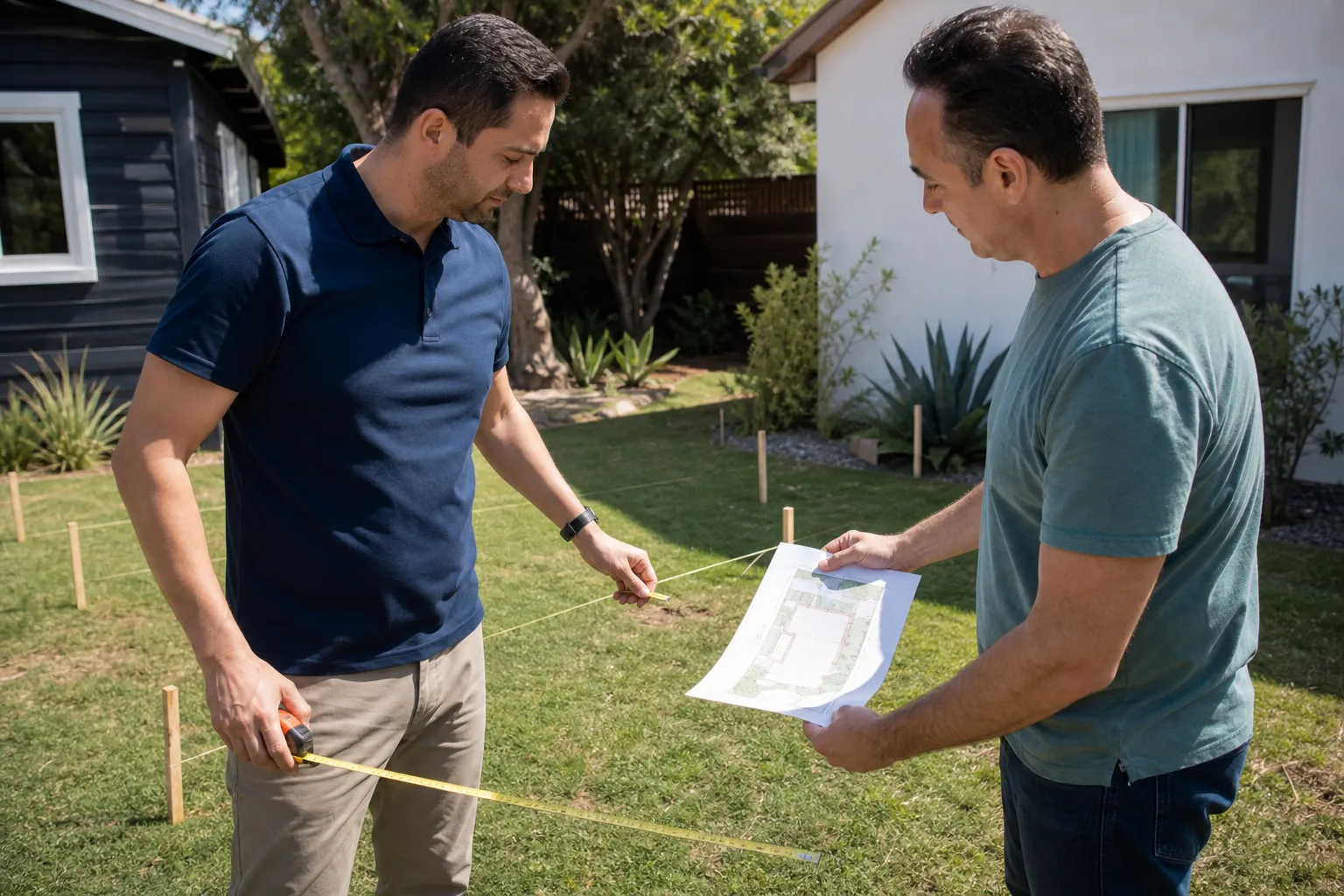
What can you legally do yourself as an owner-builder? Drywall, insulation, painting, flooring, cabinetry, trim, interior doors, and finish plumbing fixtures (after the licensed plumber roughs in the supply and drain lines). You can also run the project schedule, order materials, and pull the permit. But the moment you touch a wire, a pipe, a gas fitting, or a structural connection, you’re building an unpermitted condition that Fresno’s inspectors will catch on the next inspection or that will surface during a future sale.
The Real Cost Comparison: DIY vs Professional in Fresno
Here’s the honest math on a 750-square-foot detached one-bedroom ADU in Fresno. These are real ranges from actual Fresno projects, including material costs at current market rates, typical Fresno permit fees (which run $8,000 to $15,000 for a detached ADU depending on location and utility connection requirements), and labor at prevailing Central Valley rates.
Professional General Contractor Build
- Design and engineering: $12,000 to $25,000
- Permits and utility connection fees: $8,000 to $15,000
- Site work and foundation: $25,000 to $45,000
- Framing and structural: $35,000 to $60,000
- Electrical, plumbing, HVAC: $30,000 to $50,000
- Interior finishes: $50,000 to $90,000
- General contractor markup (15-20%): $33,000 to $57,000
- Total: $220,000 to $380,000
Owner-Builder with Licensed Trade Contractors, DIY Finish Work
- Design and engineering: $12,000 to $25,000
- Permits and utility connection fees: $8,000 to $15,000
- Site work and foundation (hired): $25,000 to $45,000
- Framing (hired for structural): $35,000 to $60,000
- Electrical, plumbing, HVAC (licensed contractors): $30,000 to $50,000
- Interior finishes (DIY, materials only): $25,000 to $45,000
- No general contractor markup
- Total: $180,000 to $260,000
So owner-builder saves roughly $40,000 to $120,000 on a detached ADU. That’s substantial. But here’s what the savings actually buys you: the general contractor’s liability insurance, their subcontractor relationships, their scheduling, their warranty, and their license on record for the resale disclosure. Ask yourself whether your own labor and stress are worth that number, and whether you know what to do when the concrete pour gets delayed by a Fresno heat wave or the electrical rough-in fails because the panel load calculation doesn’t match the utility’s requirements. Our Seasonal ADU Care for Fresno: Year-Round Homeowner’s Guide covers how extreme heat affects construction timing and system performance.
We’ve watched Fresno homeowners in neighborhoods like Tower District, Woodward Park, and Sunnyside walk both paths. The ones who succeed as owner-builders are retired contractors, engineers, or people with deep construction experience. Everyone else spends the savings on mistake fixes, change orders, and re-inspections. The ADU Builders in Fresno we compete against see this constantly: a homeowner calls six months into a DIY build, project half-finished, permit about to expire, asking for help.
Where Genuine DIY Saves Money Without Legal or Quality Risk
If you want to reduce ADU cost without the legal exposure, focus your own labor on finish work and cosmetic elements. These tasks don’t require licenses, don’t trigger inspection failures when done with basic competence, and don’t create resale disclosure problems.
- Painting. Interior and exterior painting saves $4,000 to $9,000 on a 750-square-foot unit. Fresno’s dry heat makes paint application forgiving; just schedule exterior work around the summer’s high-UV afternoons.
- Flooring. Luxury vinyl plank and laminate install are genuinely DIY-accessible. Save $3,000 to $7,000 on materials and labor. Tile is riskier: a bad tile job over an unstable substrate cracks within a year in Fresno’s temperature swings.
- Landscaping and site finish. Planter beds, drought-tolerant ground cover, decomposed granite pathways, and irrigation modifications are all homeowner work. Fresno’s turf conversion rebates can offset water costs, and this work adds curb appeal without touching the building envelope.
- Interior trim and doors. Hanging pre-hung interior doors and installing baseboards, casing, and closet shelving saves $2,000 to $5,000 and fails inspection only if you cover code-required elements like electrical panels or access points.
- Window coverings and hardware. Blinds, shades, cabinet pulls, and towel bars are zero-risk DIY that makes the unit feel finished.
- Fixture installation (after licensed rough-in). Once the plumber roughs in supply and drain lines and the electrician terminates the circuits with blank plates, you can legally install faucets, toilets, light fixtures, and switches. This saves $1,500 to $3,500.
Total realistic DIY savings on finish work: $12,000 to $25,000 without touching a wire, pipe, or structural member. That’s the sweet spot. You skip the genuine contractor savings on the expensive systems and still reduce the total by 5-10%. And you avoid signing the owner-builder liability into existence for the structural core.
Where Amateur Work Creates Inspection Failures and Expensive Fixes
Fresno’s building inspectors see owner-builder work every week. They’re not adversarial; they’re enforcing code that exists because California seismic activity and Central Valley heat create genuine hazards. Here are the specific failures we see repeated across Fresno ADU projects.
Electrical panel overloading. An ADU adds significant load to the main service panel. Fresno’s utility, PG&E, requires a load calculation for any new dwelling unit. A homeowner who runs a 100-amp subpanel off an already-loaded 200-amp main panel fails the PG&E service check. The fix: a panel upgrade costing $3,000 to $6,000 that wasn’t in the budget.
Framing connections that don’t match the engineer’s details. Fresno requires engineered plans for all new ADUs. The plans specify exactly which hold-downs, anchor bolts, straps, and nails go where. A homeowner who substitutes a different nail pattern or misses a hold-down fails the shear wall inspection. The fix: tear-out of drywall already hung (if the inspector caught it late), re-framing per detail, and a re-inspection fee.
Improper drainage and foundation elevation. Fresno sits on expansive clay soils in many areas, particularly the older neighborhoods north of downtown. Clay expands and contracts with moisture. A foundation poured without proper grade work or drainage shifts. You won’t see it in the first year. You’ll see it as drywall cracks in year two or three, after the contractor warranty has expired if this was a professional job, or with no recourse at all if you built it yourself.
Mini-split sizing errors. The most common HVAC mistake in Fresno ADUs is undersizing the system for the summer load. A 9,000 BTU unit can’t hold a 400-square-foot studio below 80°F when it’s 108°F outside and the unit faces west with unshaded windows. The fix: equipment replacement plus possibly added insulation, which means opening walls back up.
Drywall and insulation covering code-required access. Fresno code requires access to shutoff valves, cleanouts, and often the water heater. A homeowner who drywalls over the water heater shutoff or the sewer cleanout fails inspection until they cut the access back open, patch, and refinish.
Each of these failures costs $1,000 to $8,000 to fix and delays your project by weeks. Three or four failures across a build erases the entire owner-builder savings. If you want to see how professional crews handle these issues, the Home Addition Contractor in Fresno approach is built around pre-construction planning that catches these before they become inspection failures.
How Unpermitted or Partially-Permitted DIY Work Affects Taxes, Insurance, and Rentals
An unpermitted ADU in Fresno is not a hidden asset. It’s a liability that touches three systems at once: the county assessor’s office, your insurance carrier, and any future tenant relationship.
Property tax reassessment. Fresno County reassesses property when a building permit closes and the addition adds value. Permitted ADUs trigger a supplemental assessment based on the added value, typically in the range of 1.1% to 1.3% of the new construction’s assessed value per year. Unpermitted ADUs don’t trigger reassessment until discovered. When discovery happens – through a neighbor complaint, a code enforcement drive-by, or a sale inspection – Fresno County can assess back taxes for up to four years in some cases, plus penalties. The bill lands all at once.
Homeowner’s insurance coverage gaps. Most Fresno homeowner policies exclude or severely limit coverage for unpermitted structures. If an unpermitted ADU burns, floods, or causes injury, the carrier typically denies the claim on the grounds that the structure wasn’t a legal dwelling unit. Worse, some carriers are canceling policies entirely when they learn an unpermitted ADU exists on the property. A permitted ADU, by contrast, is listed on the policy as an accessory structure and covered accordingly.
Rental legality and tenant leverage. Fresno’s rental housing inspection program requires units to meet habitability standards. An unpermitted ADU doesn’t have a certificate of occupancy, which means it can’t lawfully be rented to a tenant. If a tenant in an unpermitted unit stops paying rent, the property owner has severely limited legal recourse, because the court may view the rental agreement as void. Some Fresno landlords learn this only when they try to evict a non-paying tenant from an unpermitted unit and watch the case collapse.
Resale value compression. A permitted ADU adds comp value that appraisers can verify. An unpermitted one is called “nonconforming square footage,” and many lenders simply won’t finance a purchase that includes it. You become a seller limited to cash buyers, and cash buyers price in the demolition or legalization cost. We recommend checking the Sutton ADU Fresno home page if you’re weighing whether to fix unpermitted work or start over with permitted construction.
Prefab and Modular ADUs: What Fresno Homeowners Should Know
Prefab changes the DIY-versus-professional math in a specific way. A factory-built unit from a brand like Dvele, Mighty Buildings, or Boxabl arrives at your Fresno lot largely assembled or in panelized sections. The factory handles precision, weather-tightness, and much of the finish work. But here’s what the marketing doesn’t emphasize: the site work, foundation, utility connections, and final assembly must still be performed by licensed contractors working under Fresno’s permit process.
You cannot legally connect a prefab ADU to your electrical service as a DIY project. You cannot place it on a foundation you poured without engineering and inspection. You cannot hook it to city sewer or water without a licensed plumber. What prefab genuinely eliminates is framing labor, weather delays on the structure, and some finish work. It does not eliminate the legal requirement for licensed trades at the connection points.
Here’s the realistic prefab cost picture in Fresno for 2026:
- Factory unit (400-600 sq ft, budget-to-mid range): $80,000 to $160,000
- Transport and crane placement: $5,000 to $15,000
- Foundation and site work: $25,000 to $45,000
- Utility connections (licensed electrical, plumbing, HVAC): $20,000 to $40,000
- Fresno permits and fees: $8,000 to $15,000
- Final assembly, trim, and inspection coordination: $10,000 to $25,000
Total prefab delivered and permitted: $148,000 to $300,000. That’s meaningfully less than a full site-built ADU in many cases, and it compresses the timeline from 12-18 months to 6-10 months. But it’s not a DIY shortcut. The connection work still requires licensed contractors, and the resale disclosure rules still apply if you act as your own owner-builder to coordinate the project.
Common Mistakes to Avoid
- Pulling the permit yourself and hiring unlicensed day labor for the easy-looking work. Fresno inspectors check trade licenses at each inspection. An unlicensed worker performing scopes requiring a license fails inspection and can trigger CSLB enforcement. You’ve lost the permit fee, the inspection cycle, and weeks of schedule.
- Underestimating the utility connection timeline. PG&E service upgrades and sewer or water lateral connections in Fresno take 3-6 months for scheduling in many areas. Start these the day your permit is issued, not after the walls are up.
- Assuming homeowner’s insurance covers the build. Construction on your property while you live there typically falls under a builder’s risk rider or separate policy, not standard coverage. Confirm with your carrier before the first delivery of lumber.
- Treating the owner-builder five-year resale disclosure as a formality. It’s a deal repricing tool for buyers. If you might sell within five years, the owner-builder savings should be measured against the likely resale negotiation you’re funding.
- Finishing interior work before electrical and plumbing finals pass. Fresno inspectors won’t pass a final behind finished walls without the prior inspections documented. If you drywall before the electrical rough-in signs off, you’re tearing it back out.
- Choosing the cheapest prefab unit without checking Fresno’s specific requirements. Some factory units need adaptation for California’s Title 24 energy code and Fresno’s climate zone. A unit that met code in Nevada may fail California compliance. Verify the unit’s Title 24 documentation before purchase.
When to Call a Professional
Call a professional the moment the scope touches structure, electricity, plumbing, gas, or HVAC. Call when the permit application asks for engineered drawings and you don’t have a structural engineer on speed dial. Call when the resale timeline matters to you and you don’t want the owner-builder disclosure hanging over a future sale. Call when you realize the savings aren’t savings if they buy you liability. Room Addition Contractor in Fresno work shares many of these same boundaries. If you’re in Fresno and want a straight answer about your specific lot, Sutton ADU Fresno offers free estimates: call (559) 785-0627.
Frequently Asked Questions
A detached one-bedroom ADU in Fresno typically costs $220,000 to $380,000 for a full professional build including design, permits, construction, and finishes. Prefab options from brands like Boxabl or Plant Prefab delivered and connected by licensed contractors range from $148,000 to $300,000 depending on size and site conditions. Call (559) 785-0627 with your lot size and we’ll give you a written estimate rather than a verbal range.
Yes, California allows owner-builder construction on your own property, but you must hire licensed contractors for electrical, plumbing, HVAC, and most structural work. You can personally perform finish work like painting, flooring, and trim. You also assume legal liability for jobsite safety and must disclose the owner-builder work if you sell within five years.
You’ll have to either legalize the ADU before sale, which means bringing it to current code and paying back taxes and penalties, or sell for a reduced price to a buyer who accepts the liability. Many lenders won’t finance a home with unpermitted square footage, which limits you to cash buyers who typically discount the price by 20-30% of the ADU’s would-be value.
Yes. When your permit closes, Fresno County reassesses the property based on the ADU’s added value. Expect a supplemental tax bill of roughly 1.1% to 1.3% of the new construction’s assessed value annually. A $250,000 ADU adds roughly $2,750 to $3,250 per year to your property tax bill.
Prefab or panelized construction with licensed site work and utility connections is typically the fastest legal path, at 6-10 months versus 12-18 months for site-built. The factory handles structure and much of the finish work, while Fresno-licensed contractors handle foundation, utilities, and final permits. You still need the same permits and inspections as a site-built unit.
Realistic DIY savings on finish work and project management run $40,000 to $120,000 compared to a full professional build. But that savings assumes you complete the project without inspection failures, injury claims, or resale complications. For most Fresno homeowners, the safer path is hiring professionals for the legal scopes and keeping DIY to finish work, which still saves $12,000 to $25,000. Call (559) 785-0627 to compare your specific project against a written estimate.
The Bottom Line
The DIY versus professional ADU decision in Fresno isn’t really a money question. It’s a legal exposure question. You can save real money by acting as owner-builder and doing finish work yourself, but you cannot legally touch wires, pipes, gas lines, HVAC, or structural connections. You also can’t escape the resale disclosure if you sell within five years. The practical answer for most Fresno homeowners: hire licensed professionals for everything that requires a license, do the paint and flooring yourself if you enjoy it, and keep the whole project permitted. A permitted ADU builds equity. An unpermitted one builds liability. Browse more guides & resources or call (559) 785-0627 for a free estimate and a straight answer about your lot.
Written by Miles Hartwell, Owner at Sutton ADU Fresno, serving Fresno since 2006.