Last updated October 15, 2026
How to Hire a ADU Contractor in Fresno: A Step-by-Step Guide
Fresno County has one of the highest ADU permit approval rates in California, with over 1,200 accessory dwelling units permitted in the city of Fresno alone since 2020. That volume attracts contractors, and not all of them are prepared for the soil conditions, setback codes, and heat-driven material demands specific to this valley. The Contractors State License Board currently lists over 400 active general contractors in Fresno County, and it takes under 10 minutes to verify whether the person handing you a quote is actually one of them. Most homeowners never check. This guide walks you through the three vetting checks that actually predict whether your ADU finishes on time, on budget, and with people you trust on your property, and points you to more guides & resources for every stage of your project.
Quick Answer
To hire an ADU contractor in Fresno, verify their CSLB license and insurance directly with the state, check their Fresno permit pull history and completed ADU record through public records, and require a written price lock that names exactly who will show up to your property before you sign anything. The contractor who passes all three checks is the one worth your deposit. Skip any of the three and you’re gambling on a $200,000+ project.
Table of Contents
- Check One: Run the CSLB License Verification Before You Even Take the Meeting
- Check Two: Ask Exactly Who Shows Up, Then Verify It
- Check Three: Pull the Permit History Before You Trust the Reviews
- How to Read a Fresno ADU Estimate for Hidden Cost-Shifting Language
- What a Written Price Lock Actually Needs to Say to Be Enforceable
- 15 Questions to Ask Any ADU Contractor Before Signing
- What ADUs Actually Cost in Fresno Right Now
- Common Mistakes to Avoid
- When to Call a Professional
- Frequently Asked Questions
- The Bottom Line
Check One: Run the CSLB License Verification Before You Even Take the Meeting
Here’s the reality most Fresno homeowners discover too late: the person who calls you back, schedules the site visit, and writes the quote is not always the person whose name appears on the license. And sometimes there is no license at all.
The Contractors State License Board runs a free, public license lookup tool at cslb.ca.gov. You type in a name or license number, and the system returns the license classification, issue date, expiration date, current status, workers’ compensation insurance status, and any disciplinary actions. In Fresno, an ADU project legally requires a contractor holding a General Building (Class B) license, or in some cases a Class A General Engineering license for significant site work and grading. For a deeper look at what’s required, see our guide to ADU Permits, Codes & Inspections in CA: What You Need to Know. A C-6 Cabinet and Millwork license does not authorize someone to build your ADU, no matter how confident they sound.
Run the check before you agree to a site visit. Here’s exactly what to do:
- Go to cslb.ca.gov and click “Check a License.” Use the contractor’s legal business name, not the name on the side of the truck.
- Confirm the license classification. You want Class B for most ADU builds. If your lot needs major regrading, retaining walls, or drainage engineering, you may also need Class A. Ask the contractor to explain their classification and why it fits your lot.
- Check the status field. “Active” means they can legally contract in California right now. “Expired,” “Suspended,” or “Revoked” means they cannot. Do not accept the explanation that “it’s a paperwork thing, we’re fixing it.” A suspended license is a felony to contract under in California.
- Look at the issue date. A license issued three months ago is not a disqualifier on its own, but it should shift your scrutiny. You want to see an active license that has survived at least one full renewal cycle if possible, because permits and warranty claims both test a contractor’s process.
- Check the workers’ comp box. In California, a contractor with employees must carry workers’ compensation insurance. If the field shows “Exempt,” that means the contractor has no employees and is legally operating as a sole operator. That changes who is doing the work, and you should ask about it directly.
- Read the disciplinary record. The CSLB publishes any complaints, citations, or license actions. A clear record is good. A record with resolved complaints is not automatically disqualifying, but you should ask the contractor to explain each one. If they dodge the question, that’s your answer.
What a clear CSLB record does not tell you: whether the crew that shows up is background-checked, whether the subcontractors are licensed, or whether the pricing will hold. A license is the floor, not the ceiling. It proves the contractor is legally allowed to contract. It proves nothing about how they run a jobsite.
In our experience at Sutton ADU Fresno, the homeowners who run this check and ask the follow-up questions are the ones who rarely end up in disputes. The check takes ten minutes. The average ADU dispute in Fresno County takes months and often tens of thousands of dollars to resolve.
Check Two: Ask Exactly Who Shows Up, Then Verify It
Here’s the question most Fresno homeowners never ask: “Who is physically going to be on my property, and can you prove who they are before they arrive?”
ADU construction in Fresno typically spans four to eight months. That is four to eight months of strangers walking past your kitchen window, using your side gate, and accessing your property while you’re at work, while your kids are home from school, or while you’re alone. The contractor you met at the estimate is rarely the person swinging the hammer every day. The crew is composed of employees plus subcontractors: the concrete sub, the framer, the electrician, the plumber, the drywall crew, the painter. Each of them has a name, a license status, and a background you know nothing about unless you ask.
Here are the specific questions to ask, word for word, and what the answers should sound like:
- “Who will be the project lead on site every day?” You want a single named person who is reachable by phone and accountable for daily decisions. If the answer is “we have multiple leads,” press for who is the primary. You need one throat to choke, as the saying goes.
- “Which parts of the work are subcontracted, and can you give me the name and license number for each sub before they start?” In California, a general contractor may legally hire licensed subcontractors. But you want their names in advance, and you want to run the same CSLB check on each one. If a contractor hesitates to name their subs before contract signing, that is a red flag. Legitimate builders know their subcontractor roster months in advance.
- “Are your employees and subs background-checked?” This is a yes or no question. In California, state law does not require background checks for construction workers, and most contractors do not run them. If the contractor says yes, ask what the check includes. A real answer names the screening company, the scope of the check (criminal history, identity verification, sex offender registry), and how recently the check was run. A vague answer like “oh yeah, we vet everyone” is not a system, it’s a hope.
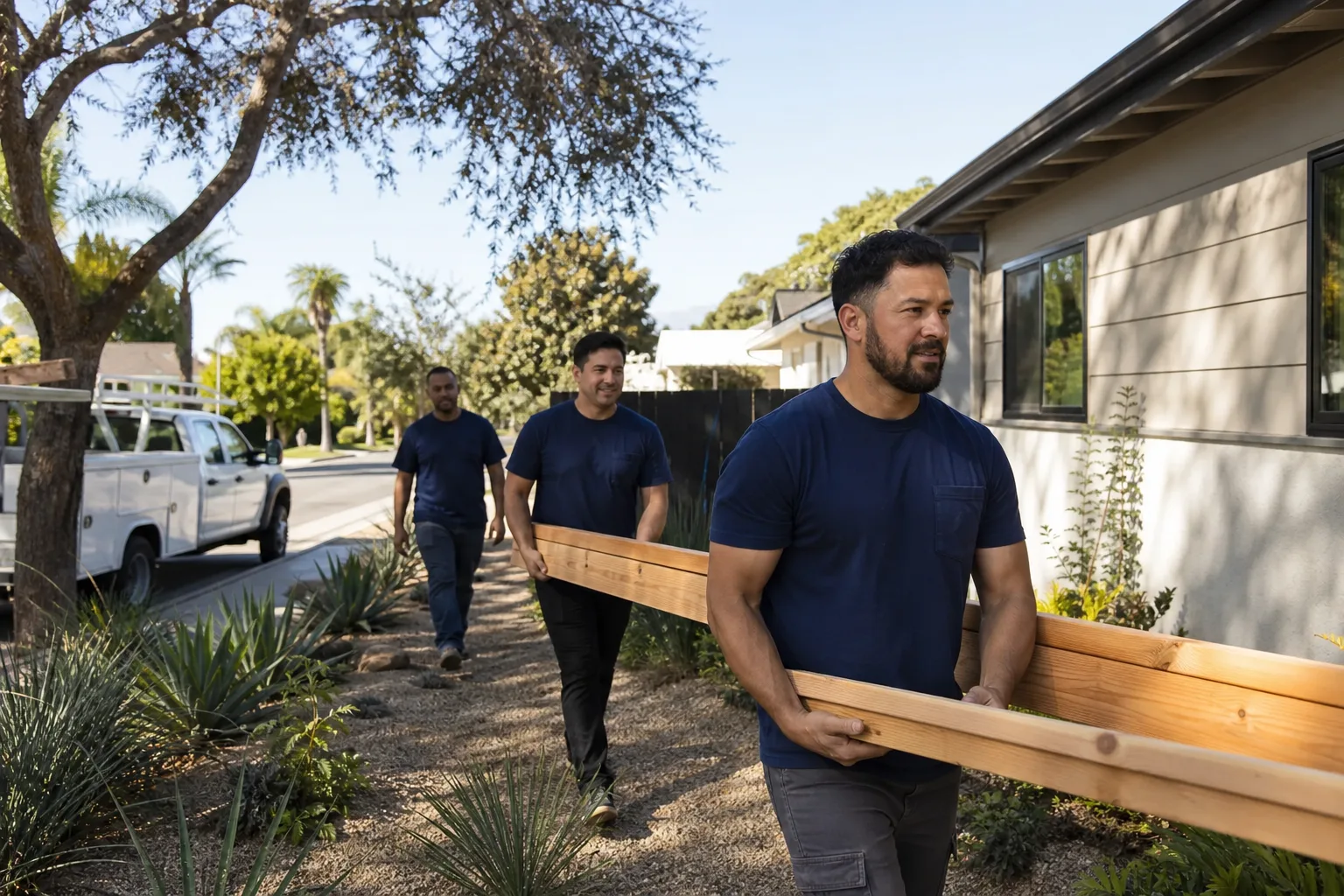
- “When your crew arrives, how will I verify who they are?” This is the question that separates professional operations from informal ones. A good answer sounds something like: “We send you the name and photo of every technician before they arrive, and they show ID at the door.” If the contractor laughs or says “you’ll know it’s us because of the truck,” that tells you something.
At Sutton ADU Fresno, this is the question we built our company around. Every field technician operates under the Threshold Verified standard: background-checked, identity-verified, uniformed, and photo-badged. Before any technician steps onto your property, we send their name and photo to you. When they knock, they show a photo ID badge at the door. This is not a courtesy. It is the Threshold Standard, and it’s written into how we operate, not into a marketing brochure.
The name Sutton comes from an old English term for a south farm, and there’s a reason that matters. Adding a second home to your lot is a settled, rooted decision. You’re not ordering a meal. You’re inviting a crew onto your land, into your daily life, for months. The people who enter that gate should be people whose names you already know.
Read more about what a home addition contractor in Fresno should be doing differently before you sign anything.
Check Three: Pull the Permit History Before You Trust the Reviews
Five-star Google reviews tell you whether a contractor was friendly and whether the finished product looked good in photos. They tell you almost nothing about whether the contractor pulled proper permits, passed inspections the first time, or has a documented history of actually finishing ADUs in Fresno.
Fresno building permit records are public. The City of Fresno Building and Safety Division maintains a permit database, and you can search by the contractor’s name or license number. Here’s what to pull and how to read it:
- Search the contractor’s name in the Fresno permit database. You want to see ADU-specific permits: Accessory Dwelling Unit, Junior ADU, detached structure, or room addition. A contractor with zero ADU permits in Fresno but a flashy website claiming “ADU specialist” is either new to the category or importing experience from another market with different soil, wind, and code conditions.
- Look at the permit close-out rate. How many permits were pulled and how many were finalized? In Fresno, a finalized permit means the project passed its final inspection. A contractor with 40 permits pulled and 28 finalized has a 30% incomplete rate, and you should ask why.
- Check for re-inspection notes. Fresno’s permit records note when an inspection failed and had to be re-run. One or two re-inspections over a long career is normal, even for good contractors. A pattern of repeated failures on the same code category (electrical, structural, plumbing) indicates a workflow problem.
- Verify the contractor pulled permits on their own past ADU projects. Some homeowners pull owner-builder permits and the contractor works under them. That is legal in California but shifts liability for code compliance onto the homeowner. You want a contractor who pulls permits under their own license and stands behind the work.
- Cross-reference the permit addresses with Fresno neighborhoods. Fresno is not one market. Soil conditions in Fig Garden and the Tower District differ from the hardpan in Clovis and the expansive clay in parts of northeast Fresno. A contractor who has never permitted in your part of town is learning on your lot.
We’ve pulled enough Fresno permit histories to say this plainly: the public record is a better predictor of project outcomes than any review platform. Reviews are written by homeowners who may not know whether their foundation was properly compacted or whether the electrical rough-in passed on the first try. The permit record does not care about feelings. It records what passed and what failed.
How to Read a Fresno ADU Estimate for Hidden Cost-Shifting Language
ADU estimates in Fresno vary wildly, not because labor and materials vary that much, but because contractors use different degrees of honesty about what is included. Our ADU Cost Breakdown: The Fresno Homeowner’s Reference for 2026 explains how to read between the line items. A $180,000 estimate from one builder can turn into $240,000 at final invoice. A $260,000 estimate from another builder can finish at $255,000. The difference is in the line items, not the headline number.
Here are the phrases that signal cost-shifting, and what an honest estimate should say instead:
- “Allowance” followed by any dollar amount. A $3,000 lighting allowance, a $6,000 tile allowance, a $4,000 appliance allowance. An allowance is a placeholder, not a price. When the materials you actually pick exceed the allowance, the difference shows up on your final invoice. A tight estimate has no allowances. It has a specific line for each item with a specific price.
- “Owner-supplied” on any structural or finish item. Owner-supplied means you are buying it and you are responsible for it showing up on the right day, undamaged, with the right specs. It also means if it fails after installation, the contractor may point to the product and walk. Some owner-supplied items are reasonable (a custom light fixture, a specific appliance), but if the estimate pushes you to supply the flooring, the windows, or the HVAC equipment, the contractor is offloading both cost and liability onto you.
- “Per plan” or “per engineering” with no dollar figure. This is a contract saying “we’ll figure out the price later.” In Fresno, where many lots require soil reports and structural engineering for expansive clay conditions, “per engineering” can add $8,000 to $20,000 to your project after you’ve already paid a deposit.
- “Excluded” buried in fine print. Read the exclusions section like a lawyer. Some Fresno estimates exclude site demolition, tree removal, sewer lateral connection, utility trenching, or fence repair. Each of those exclusions is a future invoice.
- “Price may vary based on actual conditions.” This sounds reasonable and is technically true for unknown conditions, but it should have limits. A fair contract defines the scope of variance: “If we hit rock during excavation, the additional cost is $X per cubic yard, and we will notify you in writing before proceeding.” Broad, unbounded variance language is a blank check.
An honest Fresno ADU estimate should list every trade, every material category, every connection, and every fee with a specific number. If the contractor will not write the price down before work starts, do not start the work.
Sutton ADU Fresno was founded in 2006, and in that time we’ve watched the ADU market in this valley change dramatically. One thing that hasn’t changed: the contractors who write tight, honest prices are the ones who finish their projects and stand behind them. The contractors who write loose estimates are the ones you see at the Fresno County courthouse in small claims.
What a Written Price Lock Actually Needs to Say to Be Enforceable
A verbal promise that “your price is locked” is worth exactly the paper it’s not written on. A text message that says “price won’t change, don’t worry” is better, but it still may not hold up in a California court if the scope is not defined.
For a written price lock to be enforceable in California, it needs these elements:
- A defined scope of work. The contract must describe, in writing, what is being built: square footage, room count, structural systems, materials, finishes, and connection points. If the scope is “detached ADU per plan,” the plan becomes the contract. Make sure the plan set is complete before you sign.
- A fixed total price. The contract must state one number. Not a range (“between $180,000 and $220,000”), not an estimate (“approximately $195,000”). One number.
- A change order process. The contract should describe how changes will be handled: any change to the scope must be agreed in writing, signed by both parties, and priced before work proceeds. If the contract allows the contractor to make changes without your written sign-off, the price lock is meaningless.
- A payment schedule tied to milestones, not dates. California law limits deposits for home improvement contracts to the lesser of $1,000 or 10% of the contract price. Subsequent payments should be tied to completed, inspected milestones (foundation poured, framing passed inspection, drywall complete, final inspection passed), not to calendar dates.
- An identified project timeline. The contract should state a start date, a substantial completion date, and what happens if either is missed. In Fresno, where the summer heat slows concrete work and the rainy season can stall framing, some delay is normal. What you want is a contract that defines how delay is communicated and what compensation applies if the contractor misses the deadline without cause.
- The guarantor’s legal name and license number. The entity signing the contract must match the entity on the CSLB license. If the salesperson signs as an individual but the license belongs to a corporation, and something goes wrong, you may have no one to sue.
Beware of phrases that sound protective but aren’t:
- “We won’t nickel and dime you.” This is a personality claim, not a contractual term.
- “We always finish on budget.” Unless “always” is defined in the contract with a penalty for misses, it’s puffery.
- “We’ll make it right if anything goes wrong.” What does “make it right” mean? Who defines “wrong”? Within what time period? This is a verbal assurance. A real guarantee states its terms.
The 365-Day Done Right Promise at Sutton ADU Fresno is a written guarantee stamped on every project. It covers defects in workmanship for one full calendar year from project completion. If the work isn’t right within a full year, Sutton makes it right. That’s not a verbal assurance. It’s a named document with terms, coverage, and a process. If a contractor’s warranty exists only in their sales pitch, ask them to put the terms in writing. Watch what happens.
15 Questions to Ask Any ADU Contractor Before Signing
Print this list and bring it to every contractor meeting in Fresno. If a contractor can’t or won’t answer all 15, that’s information, not conversation.
- What is your CSLB license number, and what classification do you hold?
- Can I see your certificate of insurance for general liability and workers’ compensation?
- Which parts of this project will be subcontracted, and will you provide the name and license number for each sub before they begin work?
- Are your employees and subcontractors background-checked, and can you describe what the check includes?
- Will you send me the name and photo of every technician before they arrive at my property?
- How many ADU permits have you pulled in Fresno in the last five years, and how many have you finalized?
- What is your re-inspection rate on ADU projects in Fresno?
- Will you pull the permits under your own license, or am I expected to pull an owner-builder permit?
- Does your estimate contain any allowances? If so, what are they and what happens if we exceed them?
- Are any items owner-supplied? If so, who is responsible for ordering, delivery, and warranty claims?
- What is the fixed total price, and will it be written in the contract before I pay any deposit?
- How are change orders handled, and will I approve every one in writing before work proceeds?
- What does your warranty cover, for how long, and will you provide the terms in writing before contract signing?
- What is your projected start date and substantial completion date, and what happens if you miss the completion date without cause?
- Who is the named project lead on site every day, and how do I reach them if something is wrong?
Any contractor who bristles at these questions is telling you something about how your project will go when problems arise. Problems always arise on construction projects. The question is never whether issues will occur; it’s how the contractor handles them when they do. A builder who welcomes scrutiny during the sales phase is a builder who has nothing to hide during the build phase.
What ADUs Actually Cost in Fresno Right Now
Here are realistic price ranges for ADU projects in the Fresno market in 2025, based on what we’re seeing in current building conditions and permit requirements:
| ADU Type | Typical Size | Price Range in Fresno | Typical Timeline |
|---|---|---|---|
| Garage conversion ADU | 300 – 500 sq ft | $90,000 – $160,000 | 3 – 5 months |
| Detached studio ADU (new build) | 400 – 600 sq ft | $180,000 – $280,000 | 5 – 7 months |
| Detached one-bedroom ADU | 500 – 800 sq ft | $220,000 – $350,000 | 6 – 8 months |
| Detached two-bedroom ADU | 700 – 1,000 sq ft | $280,000 – $420,000 | 7 – 9 months |
| Junior ADU (attached, with kitchenette) | Up to 500 sq ft | $70,000 – $130,000 | 2 – 4 months |
These ranges assume standard finishes, standard site conditions, and no major unforeseen soil work. Fresno’s hot, dry summers mean you should budget for higher-rated insulation and HVAC equipment than coastal California builds. See our Seasonal ADU Care for Fresno: Year-Round Homeowner’s Guide for maintenance tips that protect those investments. The Central Valley’s expansive clay soil can require deeper footings and soil treatment in some neighborhoods, particularly in older east Fresno and parts of the Tower District where grading was done decades ago under looser standards.
These numbers also assume the contractor is pulling permits properly. Unpermitted ADU work in Fresno will eventually be caught at resale, at refinance, or during a code inspection, and the cost to legalize an unpermitted structure is almost always higher than the cost of doing it right the first time.
Some homeowners in Fresno are choosing prefab and modular ADU product lines to control costs and shorten timelines. Companies like Abodu, Cover, and Dvele build factory-constructed ADUs that arrive on a truck and get craned onto the site. We work with several of these product lines and can tell you honestly that a prefab ADU is not always cheaper than site-built, but it is often faster and more predictable. We also convert Tuff Shed structures into permitted ADUs for homeowners working with tighter budgets, and we install James Hardie cladding systems on both site-built and prefab projects because the Hardie product holds up better than wood siding in Fresno’s summer sun.
The right product line for your lot depends on your access, your soil, your setback, and your budget. You’ll get straight guidance on that when you ask the right questions of the right builder. Read about how room additions differ from ADUs in Fresno if you’re weighing both options.
Common Mistakes to Avoid
- Hiring the first contractor who returns your call. The most available contractor in Fresno is often the one with no backlog, and no backlog sometimes means no reputation. A quality ADU builder in this market typically has a wait list. That wait is usually worth it.
- Skipping the CSLB check because the estimate was impressive. An impressive estimate from an unlicensed operator is worthless. If they can’t legally contract, they can’t legally build your ADU, and you may have no recourse when the project stalls.
- Signing a contract with allowances. Allowances are future invoices waiting to happen. If your contractor can’t give you a fixed price on tile, flooring, and lighting before contract signing, they haven’t actually priced your project.
- Accepting a warranty that exists only in the sales conversation. If the warranty terms aren’t written into the contract, there is no warranty. Period.
- Choosing the lowest bid without comparing scope. In Fresno, a $50,000 gap between two bids on the same project almost always means one contractor is excluding work the other includes. Compare line items, not totals.
- Not asking who will be on the property. You will let strangers onto your property for months. Not knowing who they are, whether they’re background-checked, and how you’ll identify them at the door is a choice you don’t get to unmake.
- Assuming five-star reviews mean the permits are clean. Reviews don’t show in the City of Fresno permit database. The permit database does. Check both, but trust the permit record more.
When to Call a Professional
If you’re not sure whether your lot meets Fresno’s ADU setback and lot coverage requirements, call a professional. If you’re not sure whether your existing garage foundation can support a conversion, call a professional. If you’re considering a detached ADU on a lot with known expansive clay soil, call a professional. If you’re looking at a prefab product line and want honest guidance on which brand fits your site, call a professional who has installed more than one brand and can compare them without a sales commission clouding the advice.
ADU construction in Fresno is not a weekend project and it is not a skill you acquire from YouTube. It is a months-long structural build with code compliance, inspections, and safety implications. The margin for error on a foundation or roof assembly is zero. Sutton ADU Fresno offers free estimates in Fresno, and we will answer your questions whether or not you hire us. Call (559) 785-0627.
Frequently Asked Questions
Yes. Every ADU in Fresno requires a building permit from the City of Fresno Building and Safety Division, and the work must pass inspections at the foundation, framing, rough-in, and final stages. Unpermitted ADU work in Fresno will surface at resale or refinance and will cost more to legalize retroactively than to permit correctly from the start. Call (559) 785-0627 to talk through the permit process for your specific lot.
A garage conversion in Fresno typically takes 3 to 5 months, a detached one-bedroom ADU 6 to 8 months, and a two-bedroom detached ADU 7 to 9 months from permit approval to final inspection. Permit review time at the City of Fresno can add 2 to 3 months before construction begins, depending on plan completeness and current city workload.
Most ADU projects in Fresno run between $90,000 and $420,000 depending on type, size, finish level, and site conditions. A garage conversion typically runs $90,000 to $160,000. A detached ADU ranges from $180,000 to $420,000. Site-specific factors like soil conditions, utility trenching, and setback constraints can move the number significantly. Call (559) 785-0627 for an exact quote on your lot – estimates are free.
In some cases, yes. Tuff Shed structures can be converted into permitted ADUs if the original structure meets structural code requirements and the conversion adds proper insulation, electrical, plumbing, and a kitchen or kitchenette as Fresno code requires. Not every Tuff Shed is a candidate. The structure needs to be evaluated by a licensed contractor before you assume it can be legally converted.
Prefab ADUs from companies like Abodu, Cover, and Dvele often arrive faster and with more predictable factory quality, but they aren’t always cheaper after site work, foundation, utility connection, and crane placement are factored in. Site-built ADUs offer more design flexibility and may be more cost-effective on lots with unusual shapes or access constraints. The right answer depends on your specific lot. Call (559) 785-0627 and we’ll give you an honest comparison for your property.
First, stop work if you have safety concerns. Second, run the CSLB license check immediately. Third, pull the permit history on your property and on the contractor’s name. Fourth, read your contract for change order, cancellation, and warranty terms. If you’re within three business days of signing a home improvement contract in California, you may have cancellation rights under state law. If the contractor has breached the contract, document everything in writing and seek legal advice.
The Bottom Line
Hiring an ADU contractor in Fresno is a vetting process, not a price comparison. The three checks that matter are the CSLB license verification, the crew identification and background verification, and the public permit history. Run all three before you sign anything. Then demand a written price lock with no allowances, named subcontractors, and a warranty with actual terms in writing. The contractor who clears all of this is the one who will finish your ADU on time, on budget, and with people you trust. Everyone else is an expensive lesson waiting to happen.
Written by Miles Hartwell, Owner at Sutton ADU Fresno, serving Fresno since 2006.